Archive

Posts Tagged ‘eurozone debt crisis’

Fitch Ratings Agency Downgrades Eurozone Countries

January 31st, 2012

Following in the wake of a string of downgrades of the Eurozone, including S & P cuttings its rating on France, Fitch has joined in with its own updated list of woes. Italy, Spain, Belgium, Slovenia and Cyprus have had their sovereign debt ratings cut by Fitch, just before the most recent Eurozone emergency leaders summit on the sovereign debt crisis. It seems surreal that the most recent emergency meeting is on the topic of “economic growth,” just as more quarterly results show  negative growth from various Eurozone members.

It is unlikely that the increased rhetoric emanating form the mouths of European politicians that their monetary bloc is just on the cusp of a new wave of economic growth will impress the ratings agencies. The question then is this; who will investors trust? Will it be the ratings agencies, which are falling all over each other in their ratings cuts and negative outlook with respect to the Eurozone, or will they place their bets on European politicians, who so far are batting a big fat zero in all their multitude of prognostications on the trajectory of the global economic crisis? I suspect the answer will not surprise many.


photo

global economic crisis , ,

IMF Cuts Global Economic Growth Forecast

January 25th, 2012

The International Monetary Fund has another revised global forecast that reflects growing pessimism. In the debt-crisis ravaged Eurozone, the IMF now projects negative growth of minus .5 percent, in effect a double-dip recession. A recession means plummeting tax revenue, rendering the sovereign debt crisis even more  virulent.

While the IMF still projects overall global growth, though at a lower projected 3.3 percent, its latest report states that this strangely optimistic projection is “predicated on the assumption that in the euro area, policymakers intensify efforts to address the crisis.” In other words, the Eurozone must reverse its fiscal austerity, and once again engage in deficit stimulus spending.

What the IMF seems to ignore is that the bond market is increasingly unlikely to lend money to debt-strapped European economies at interest rates that are sustainable. Or, perhaps, the IMF is hoping it will gain a massive cash infusion so it can bail out Eurozone economies, or the European Central Bank will get the hint, and start running its printing press at maximum velocity. But not even the ECB’s printing machine, along with the IMF, can easily sort out this economic and fiscal crisis.


photo

global economic crisis , , ,

Dire Warning From World Bank on Eurozone Debt Crisis

January 20th, 2012

The World Bank has released a report, Global Economic Prospects 2012, which lowers previous forecasts on global economic growth and presents a grim picture of what lies ahead. The World Bank now projects global growth at 2.5 percent, with virtual stall speed for advanced economies. The report makes clear that the repercussions of the Eurozone debt crisis are now worldwide.

Developing economies are still projected to have a higher growth rate than developed economies, but at a slower rate, due to overall global contraction resulting from the sovereign debt crisis in Europe.  In a warning to developing economies, Justin Yifu Lin, the World Bank’s chief economist said, “developing countries need to evaluate their vulnerabilities and prepare for further shocks, while there is still time.”  It should be added that all countries need to be prepared for future shocks, as the Eurozone debt crisis, now rampaging for two years, seems likely to get a lot worse during the course of 2012.


photo

global economic crisis , , ,

IMF Head Christine Lagarde Warns On Economic Crisis Becoming Another Great Depression

December 16th, 2011

The International Monetary Fund’s boss, Christine Lagarde, has issued another warning regarding the global economic crisis. This time, she spoke in Washington DC about  the danger of another Great Depression unless all countries work together to resolve the Eurozone sovereign debt crisis. If they don’t act in unison and effectively, Lagarde said the consequences would be, “Protectionism, isolation, and other elements reminiscent of the 1930s Depression.”

The grim outlook from the IMF is in sequence with cascading warnings from France and Germany that unless fiscal policy in the Eurozone becomes “harmonized” (e.g. more erosion of national sovereignty) and other countries outside the Eurozone (especially China) provide funding for the “big bazooka” to backstop the danger of sovereigns becoming insolvent, the global economy will implode. What the IMF and the politicians have not said is that it is politically impossible for them to obtain all the scenarios they claim are needed to prevent outright catastrophe.


photo
Officer Larry of the NYPD is on his way to Zuccotti Park in lower Manhattan to arrest peaceful protesters involved with the Occupy Wall Street movement. Being a public spirited member of the New York Police Department, Officer Larry does remind us that there is a global economic crisis underway that rivals the Great Depression of the 1930s.

global economic crisis , , ,

Global Economic Crisis Is Now A Depression: Paul Krugman

December 12th, 2011

Nobel Prize winning economist Paul Krugman, in his recent column, has declared that the crisis in the global economy is now a depression.  Since the onset of the global economic crisis, policymakers and media pundits have resisted using the “D” word, instead preferring terms such as the “Great Recession.” However, this is what Paul Krugman wrote in his  December 11, 2011 New York Times column:

It’s time to start calling the current situation what it is: a depression. True, it’s not a full replay of the Great Depression, but that’s cold comfort. Unemployment in both America and Europe remains disastrously high. Leaders and institutions are increasingly discredited. And democratic values are under siege. .. Specifically, demands for ever-harsher austerity, with no offsetting effort to foster growth, have done double damage. They have failed as economic policy, worsening unemployment without restoring confidence; a Europe-wide recession now looks likely even if the immediate threat of financial crisis is contained.”

Krugman points out in his piece that the economic disaster now unfolding in Europe threatens a resurgence of anti-democratic, populist authoritarianism of the type that infected European civilization during the Great Depression of the 1930s.Of course, the same dangers also lurk in the United States.

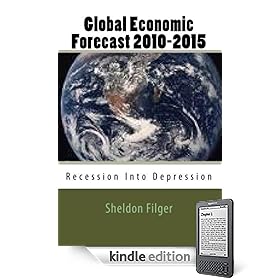
In my book, “Global Economic Forecast 2010-2015: Recession Into Depression,” I predicted in 2009 that the policy responses following the collapse of Lehman Brothers in 2008 would not only fail to resolve the global financial and economic crisis; they would create a sovereign debt contagion that would transform the recession into a depression.  Paul Krugman has confirmed the validity of my forecast made in 2009.

In his closing observation, Paul Krugman offers an ominous warning. After describing how Hungary, one of the new democracies in Eastern Europe, is receding into authoritarian rule as its politics become more extremist, all due to the economic crisis in Europe, Krugman writes about the Eurozone political leaders,  they also need to rethink their failing economic policies. If they don’t, there will be more backsliding on democracy — and the breakup of the euro may be the least of their worries.”

It appears that the global economic crisis, and Eurozone debt crisis, are increasingly becoming a political crisis.


photo
Officer Larry of the NYPD is on his way to Zuccotti Park in lower Manhattan to arrest peaceful protesters involved with the Occupy Wall Street movement. Being a public spirited member of the New York Police Department, Officer Larry does remind us that there is a global economic crisis underway that rivals the Great Depression of the 1930s.

global economic crisis , , ,

Standard & Poor’s Places Eurozone On Credit Watch

December 7th, 2011

After months of individual sovereign downgrades by the three leading ratings agencies, S & P has now entered a quantum leap by placing almost the entire Eurozone on a credit watch, including the behemoth economies of Germany and France. Furthermore,  Standard & Poor’s followed up by placing the European Financial Stability Facility, the vehicle for supposedly bailing out problematic Eurozone sovereigns and banks, on a negative credit watch. The fact that even the EFSF is on the verge of a downgrade, along with potentially almost all the sovereign states using the euro, is proof positive that the Eurozone debt crisis is irreversible, the politicians have lost control, and when the inevitable downgrades follow this devastating credit warning from S & P, all hell will break loose.

In the meantime, the clownish politicos of the Eurozone continue their interminable series of emergency meetings, continuing to promise a final and complete solution to the Eurozone debt crisis. However, in a rare moment of candor, German Chancellor Angela Merkel admitted that at best, a solution was years away.   Given all that, will China and the other BRIC nations, along with private investors, really want to invest in Euro bonds? 


photo
Officer Larry of the NYPD is on his way to Zuccotti Park in lower Manhattan to arrest peaceful protesters involved with the Occupy Wall Street movement. Being a public spirited member of the New York Police Department, Officer Larry does remind us that there is a global economic crisis underway that rivals the Great Depression of the 1930s.


global economic crisis , , ,

China’s Economy Is Contracting In The Industrial Sector

December 2nd, 2011

The figures for China’s purchasing managers’ index (PMI) for November registered a mere 49 points, according to the China Federation of Logistics and Purchasing. This figure represents a contraction in the crucial Chinese manufacturing sector. It has been due to its role as factory to the world that China’s GDP has been propelled to the second largest in the world. The latest PMI has been amplified by a similar index compiled by HSBC, which is also reporting a contraction in the industrial sector. This dismal news on the supposedly rapidly growing Chinese economy is being attributed to a decrease in exports to the Eurozone countries, now mired in an ever-worsening sovereign debt crisis. The data on China’s PMI is the worst since February 2009, at the tail-end of the free fall contraction in the global economy after the onset of the global economic crisis in the fall of 2008.

How worried should one be about the industrial contraction in China? Many observers have already pointed out that China’s rapid growth at a time of economic decline and stagnation among advanced economies was in large part artificially induced by massive government spending, in particular on uninhabited apartment complexes and unoccupied shopping malls. But more importantly, how worried is China about the economic health of its largest customers, in both the Euozone/UK region and the United States? This is what Chinese Vice Finance Minister Zhu Guangyao said about the current global economic crisis: “The current global crisis may be in some way more severe and challenging than that of 2008 after the collapse of Lehman Brothers.”

The Chinese political leadership is clearly worried about the spillover effects of the Eurozone debt crisis on China. This has led to some radical about-turns in economic policymaking. Concerns about inflation and banks with a significant portfolio of bad loans have been discarded. The authorities in Beijing are again focused on growth at all costs, involving the loosening of monetary policies and requirements on Chinese banks for minimal provision for reserves against bad loans. However, with a much smaller proportion of its economy driven by domestic consumption compared to the Eurozone, U.K. and U.S., there is only so much the government can do to induce growth at a time of stagnation or contraction of its exports to its largest customers. In the final analysis, China cannot go on indefinitely building uninhabited cities as a means of creating “growth” in its GDP. 

Despite all the talk in economic circles about the large economies in East Asia being “decoupled” from the advanced economies in Europe and North America, China is as much a prisoner of the impact of the Eurozone debt crisis as is America-just as Europe and China were prisoners of the subprime mortgage meltdown in the United States. In our integrated global economy, no one is immune to the effects of a legacy of bad economic and fiscal policymaking in Washington and Brussels, least of all Beijing.


photo
Officer Larry of the NYPD is on his way to Zuccotti Park in lower Manhattan to arrest peaceful protesters involved with the Occupy Wall Street movement. Being a public spirited member of the New York Police Department, Officer Larry does remind us that there is a global economic crisis underway that rivals the Great Depression of the 1930s.


global economic crisis , , , ,

Eurozone Debt Crisis: OECD Warning On European Recession

November 29th, 2011

The Organisation for Economic Co-operation and Development has revised its economic forecast for the Eurozone and the UK. In both areas, the OECD is predicting negative growth in Q4 of 2011 and Q1 of 2012. Two consecutive quarters of negative GDP growth meets the technical definition of a recession. Other economists believe that the Eurozone, United Kingdom and the United States have already entered a double-dip recession.

As the global economic crisis worsens, the debt crisis metastasizes and more and more sovereigns are having their public debt downgraded by the ratings agencies, the equity markets are soaring again. Why is that happening, when global economic and financial fundamentals are so rotten? It appears that a false rumour that the IMF was going to bailout Italy from its suffocating public debt was the catalyst for the stock markets to rally strongly. Even when the report was officially denied, the equities maintained their climb. It must be that equities reside in a parallel universe, devoid from the inconvenience of fiscal, financial and economic reality.


photo
Officer Larry of the NYPD is on his way to Zuccotti Park in lower Manhattan to arrest peaceful protesters involved with the Occupy Wall Street movement. Being a public spirited member of the New York Police Department, Officer Larry does remind us that there is a global economic crisis underway that rivals the Great Depression of the 1930s.

global economic crisis , ,

Spain Debt Crisis: Borrowing Costs Soar

November 17th, 2011

The debt crisis contagion in the Eurozone continues to metastasize. With Italy’s ten year government bonds above the red line of 7 percent yields despite a new government, Spain is now approaching that same zone of danger. Spanish government bonds with ten year maturities are very near the toxic level of 7 percent. With the two largest PIIGS nations in the Eurozone on the verge of insolvency, it is quite clear that the attempts to a avoid a contagion from the Greek debt crisis have been a monumental failure.

The politicians in Europe are so desperate that they have actually ditched democracy in a last ditch effort to avert a catastrophic implosion of the Eurozone.  Appointing  unelected governments and forbidding popular votes on economic and fiscal policy , not to mention eroding national sovereignty are the last refuge of the bumbling European politicians. The latest developments in the Spanish debt crisis show that these desperate measures are likely to be as dysfunctional as all other previous efforts to forestall an inevitable disaster from occurring.


photo
Officer Larry of the NYPD is on his way to Zuccotti Park in lower Manhattan to arrest peaceful protesters involved with the Occupy Wall Street movement. Being a public spirited member of the New York Police Department, Officer Larry does remind us that there is a global economic crisis underway that rivals the Great Depression of the 1930s.


global economic crisis , , ,

Italy In Distress: Italian Debt Crisis Now Center Of Gravity In The Eurozone

November 8th, 2011

The Eurozone’s latest Greek debt bailout plan, following previous Greek, as well as Portuguese and Irish bailouts, was supposed to ring-fence the largest PIIGS nations; Spain and Italy. The Spanish economy is highly vulnerable to a raging economic recession and massive unemployment. However, it is Italy, with a two trillion euro public debt and stagnant economic growth, that is now the greatest danger to the Eurozone. The supposed ring-fencing of Italy that was the prime motivation for the Greek debt write-off and bailout is clearly a failure. Only days after the latest Eurozone debt crisis plan, spreads on Italian government bonds are soaring.

The latest yield on ten year bonds issued by Italy is now in excess of 6.6 percent. Should  these yields pass seven percent, it becomes mathematically impossible for Rome to finance its deficits and debt repayments. That would mean that the Italian government would require being bailed out. The problem, however, is that there is not enough resources available in the Eurozone to bail out Italy. The only hope left, and it is a feeble one at best, is that Italian Prime Minister Silvio Berlusconi will resign, and thereby restore some level of market confidence. However, the problems with Italy’s finances go beyond one single bumbling politician. The issues are structural, not personality-based, and so far no real viable solutions have emerged.

A full-fledged Italian sovereign debt crisis will probably be the kiss of death to the Eurozone, at least in its present form.


photo
Officer Larry of the NYPD is on his way to Zuccotti Park in lower Manhattan to arrest peaceful protesters involved with the Occupy Wall Street movement. Being a public spirited member of the New York Police Department, Officer Larry does remind us that there is a global economic crisis underway that rivals the Great Depression of the 1930s.

global economic crisis , , ,