Archive

Posts Tagged ‘Fed Chairman Ben Bernanke’

America and Europe on the Brink of Economic Disaster

September 5th, 2011

Not much talk anymore about green shoots from U.S. Federal Reserve chairman Ben Bernanke. Despite infinite and very creative attempts by politicians in the U.S., the U.K. and the Eurozone to twist and spin economic statistics to make it appear that the world is indeed recovering from the global economic crisis, the data that is emerging is so bad it can no longer be “massaged.” The latest jobs report from the United States showed that in the month of August, zero jobs were created by the economy. The official news was bad by itself, but it hides an even worse reality. Even with no net new jobs created, the official discounted unemployment rate in America remained at 9.1percent. With approximately 200,000 new adults entering the work force each month, the only way that could have happened with no change in the U3 unemployment rate is if 200,000 discouraged job seekers left the labor market, or were merely eliminated form the ranks of the unemployed by the slick action of a statistician’s pencil.

While America’s jobs crisis worsens, Europe has its own woes to contend with. The sovereign debt crisis is clearly getting more dangerous, with both Spain and Italy increasingly vulnerable to the bond vigilantes. And the U.K. is experiencing sluggish or non-existent economic growth, in the process undermining the objectives of its austerity program. The global economic and fiscal situation is so bad, even the IMF is starting to hit the panic button. I think the happy talk from politicians may just about have run out of steam.


photo

global economic crisis , , ,

U.S. Economy Performing Much Worse Than Earlier Reported

July 31st, 2011

The U.S. Commerce Department issued revised figures for the first quarter of 2011. It had earlier reported an annual rate of anemic GDP growth of 1.9 percent for Q1. Even if that number had been accurate, it was insufficient to reverse the catastrophic rate of unemployment and underemployment in the United States. The revised numbers are now in; the Commerce Department now says that actual GDP growth in the first quarter of 2011 was a virtually non-existent 0.4 percent. It also issued preliminary growth figures for Q2 of 1.3 percent, worse than expected. As with the Q1 data, it is likely that future revisions will show that Q2 did even worse.

What conclusions can one draw from this miserable economic data? Two things come to mind. In the first place, any preliminary numbers on the U.S. economy that derive from official government sources are highly suspect, and likely to be overly optimistic. Secondly, after an unprecedented level of public debt that is leading America towards fiscal ruin, the best that can be accomplished by the Washington policymakers is a Japanese-style “L” shaped recession. 

Now, what happens to the U.S. economy when the pump-priming stops, as will inevitably happen?  With revenue at historic lows and public expenditures at unprecedented highs as a proportion of the national economy, the frail American  economic edifice is floating on an ocean of unsustainable debt. While the current fiscal trajectory of the United States is headed towards a calamitous train wreck, a self-imposed and immediate elimination of the deficit, or even talk of such a possibility, will further exacerbate the economic crisis that never ended in America, despite official pronouncements.

 In the meantime, the U.S. political establishment cheerfully debates the debt ceiling. Both sides of the argument are in denial. The bottom line that both Republicans and Democrats refuse to confront is that the authorship of the present economic and fiscal crisis is bipartisan. The only hope of avoiding a full-fledged American sovereign debt crisis and its apocalyptic ramifications is creating a path towards much higher levels of growth that will reduce the ratio of debt to GDP to levels that can be sustained into the future. Instead of a serious policy debate, however, both parties are engaged in an ideological debate on cloud nine, divorced from the miserable reality of an American economy that is imploding.

If this is not an indication of dysfunction in Washington, I don’t know what is. Maybe the policymakers are not worried because they know that Fed Chairman Ben Bernanke will soon ramp up his printing press again. I am more inclined towards the vision of Dante than Bernanke, when it comes to the future of the U.S. economy.


global economic crisis , , , ,

Fed Chairman Ben Bernanke Appears Clueless as Global Economy Sinks

June 9th, 2011

Alan Greenspan, former Fed Chairman and a prime facilitator of the U.S. housing bubble, appears in retrospect a scion of fiscal prudence in comparison with his successor, Ben Bernanke.  This disaster-prone Fed Chairman presided over the financial collapse of 2008, which came in the wake of his prediction that the housing bubble would not cause a recession, let alone a global financial meltdown. And this man is still the most powerful architect of U.S. monetary policy?

 In his recent speech delivered at the International Monetary Conference in Atlanta, Bernanke blamed everything but himself for what he concedes is anemic economic growth, which he knows all too well is being artificially propped up by the most expansive monetary and fiscal policies in human history. In the Fed Chairman’s world, the earthquake and tsunami in Japan, weather conditions and other unpredictable “acts of God” are to blame, not the Federal Reserve’s polices, for the utter disaster that the U.S. and many other advanced economies are coping with.

While in Atlanta, Ben Bernanke made passing reference to the sharp rise in commodity prices, though without admitting that this was due largely to the Fed’s policy of quantitative easing. He then added the illogical assessment that inflation is “not broad based” in the economy. Really?

As he has done before, Bernanke made perfunctory remarks about the need for the policymakers to eventually bring down the U.S. federal government’s budget deficit. As he and his colleagues continue to propel the United States towards a fiscal train wreck, he holds the politicians with no power to rein in Bernanke with responsibility for preventing the future shocks that the Fed’s policies have in store for everyone.

The disconnect this man has with the real world is mind-numbing. One thing, however, we can be thankful for. At least Bernanke has avoided the personal behavior issues that led to the recent resignation of the head of the IMF. With Fed Chairman Ben Bernanke, the question is all about his performance as Fed Chairman, and nothing else. On that score, history will probably judge President Barack Obama harshly for reappointing Ben Bernanke as Fed chairman.


global economic crisis , , ,

U.S. Housing Market Continues To Be An Economic Disaster

March 3rd, 2011

Ground zero of the global financial and economic crisis of 2008, the collapse of the U.S. residential housing market, remains in critical condition. Despite trillions of dollars in public debt utilized as a backstop for the mortgage industry and gimmicks like tax credits for new home purchasers, the stream of date shows that the overarching trend in the United States is continuing home price deflation, as a rising proportion of outstanding mortgages  are under water.

One recent survey indicates that in January of this year 27 percent of all American mortgages were under water (balance of mortgage exceeds market value of home),compared with 20 percent in August 2010. The National Association of Realtors Pending Home Sales Index most recently has tracked downward movement on home sales, and prices in most parts of the United States continue to decline.

With a weak housing market in the U.S. seemingly immune to massive injections of borrowed public money, no wonder Fed Chairman Ben Bernanke is printing money like a crazy man on LSD. His most recent bout of quantitative easing does not seem to have stimulated the domestic housing market at all, though it has pumped up the Dow Jones index to absurd ratios of price to earnings. However, as 2008 demonstrated the centrality of housing to the U.S. economy and not its hyperbolic stock market, the continuing weakness in this core sector does not bode well for a sustained recovery, both in America and throughout the global economy.


global economic crisis , , ,

U.S. Structural Unemployment Rate Stuck at Record High

December 6th, 2010

The latest U.S. official employment data states that fewer than 40,000 new jobs were created in November, well below the level required to cover new entries into the workforce due to natural population growth. Officially, the U.S. unemployment rate stands at 9.8%, though factoring in discouraged workers and part-time employees unable to find full-time work, the actual figure hovers near 20 percent. More alarmingly, long-term unemployment in America stands at the highest level since the Great Depression of the 1930s.

Despite the dismal employment numbers, there remains among economic commentators in the United States eternal optimists who believe there are still “green shoots” pointing to an economic recovery. Some even maintain that the actual job creation numbers for November are much higher than the official numbers, despite much more voluminous contrary evidence.

In contrast with the optimists, the Federal Reserve Chairman, Ben Bernanke, is already hinting at the need for a third round of quantitative easing, after his recent unleashing of QE2, a $600 billion orgy of money-printing by the Fed. Bernanke knows that the employment situation in the U.S. is a catastrophe, meaning there can be no consumer-led recovery of the economy, that at a time when the Obama stimulus money is running out. With a second stimulus program off the table now that the Republicans have taken control of the House of Representatives, the Federal Reserve sees itself as the only avenue for stimulus in a desperate drive to revive job creation in America. However, to think that monetary policy can be more effective than fiscal policy in facilitating job creation seems like the last great gasp of an incorrigible fool.

http://www.prlog.org/10509508-global-economic-forecast-20102015-recession-into-depression-kindle-edition.jpg

global economic crisis , , ,

Desperate Federal Reserve Speeds Up the Printing Presses :$600 Billion in QE2

November 3rd, 2010

Ben Bernanke, Chairman of the Federal Reserve, is up to his old tricks and gimmicks. His earlier bout of quantitative easing, totaling nearly two trillion dollars, was a miserable failure, attested to by an official U.S. unemployment rate of 9.6% and unofficial but more accurate rate of 17 percent, when underemployed and discouraged workers are accounted for. With no likelihood that Congress will spring for a second economic stimulus spending program, Bernanke and the Fed are now implementing QE2.

The second round of quantitative easing by the Federal Reserve will involve the purchase of 600 billion dollars in long-term U.S. Treasuries by the 2nd quarter of 2011. This is a gamble by the Fed, which I don’t see having a snowball’s chance in hell of being any more effective than the first round of quantitative easing. Furthermore, printing money out of thin air to buy government debt, in effect monetizing the debt, creates the risk of severe inflation, failed treasury auctions and the radical devaluation of the U.S. dollar.

It may be that Bernanke is doing QE2 precisely to weaken the dollar, though he would never say so publicly. In theory, a weaker dollar would make U.S. exports more competitive, leading to the creation of new jobs. However, as reported in an earlier blog, virtually every major economy is manipulating its currency in a race to the bottom. Not even dollar devaluation, if that is the Fed’s goal, will reverse the negative character of the U.S. economy and its grim unemployment crisis.

global economic crisis , , ,

Federal Reserve Begins Massive Monetization of U.S. Government Debt

August 11th, 2010

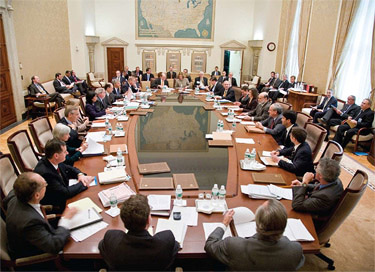
In a step that will be one of the markers on the road to economic and financial catastrophe, the Federal Open Market Committee (otherwise known as the FOMC) of the Federal Reserve, made a bombshell policy decision on August 10, 2010, one fraught with dangerous long-term consequences for the American and global economy. In a policy being dubbed QE2, the Federal Reserve’s FOMC conceded that the so-called U.S. economic recovery has “slowed,” and required more stimulus from the Fed. However, with federal funds interest rates now effectively at zero, the only aspect of monetary policy left is money printing. Thus, the Federal Reserve, in effect, will use its printing press to buy long-term U.S. government debt.

Of course, that is not how the FOMC is positioning this major escalation in quantitative easing by the Federal Reserve. In the dry, obtuse language that the obscurantists of the Federal Reserve love to engage in, the committee’s official statement said:

“To help support the economic recovery in a context of price stability, the Committee will keep constant the Federal Reserve’s holdings of securities at their current level by reinvesting principal payments from agency debt and agency mortgage-backed securities in longer-term Treasury securities. The Committee will continue to roll over the Federal Reserve’s holdings of Treasury securities as they mature.”

In  its first bout of heavy quantitative easing, in the wake of the implosion of the major Wall Street investment  banks in the fall of 2008, Ben Bernanke, utilizing his printing press, purchased $1.25 trillion in mortgage-backed securities, and an additional $200 billion in debts owed by so-called government-sponsored enterprises, primarily Freddie Mac and Fannie Mae. This massive explosion in the Fed’s balance sheet has thus far failed to stimulate economic activity and retard a persistent deflationary recession. All that Bernanke has accomplished has been to create a new asset bubble, this time on Wall Street, with equities exploding in price far beyond their post-crisis lows. Beyond the Dow Jones index, however, the impact of Bernanke’s balance sheet expansion has been impotent in the face of economic realities, particularly a collapsing labor market and the contraction in consumer demand. The erosion in the M3 money supply, a statistic the Federal Reserve no longer publicly discloses, attests to the failure of its policies.

Now that the Federal Reserve admits, though in its typically obscure linguistic constructs, that a double-dip recession is becoming increasingly likely, Bernanke is going to enter a buying binge of long-term U.S. Treasuries. The hope is that this will stabilize financial markets, and somehow force liquidity into the economy. That, at least is the hope. Given Ben Bernanke’s track record, I would not bank on hope in the infallible judgement of the Federal Reserve and its FOMC.

What is likely to result from the QE2 phase of the Federal Reserve’s disastrous policymaking? In time, sovereign wealth funds will recognize Bernanke’s manoeuvre for what it is: monetization of the U.S. national debt. When that happens, Treasury auctions will begin to fail, and yields will advance. This will all put added pressure on the Fed to print even more dollars, and monetize an increasing proportion of the federal government’s debt. This will unquestionably inject liquidity into the U.S. economy. But this Federal Reserve monetary injection will be as beneficial as money printing was in Weimar Germany in the early1920s, or Zimbabwe more recently.

In deciding on a process that will lead to an ever-growing proportion of the U.S. national debt and yearly budget deficits being monetized by its printing press, the Federal Reserve, under the leadership of its chairman, Ben Bernanke, has taken a fateful step towards irredeemable economic and financial ruin, ultimately convulsing America with a savage, hyperinflationary depression. And, as history teaches us, severe economic depressions bring along other unanticipated consequences, often leading to political and social turmoil and even global war.

global economic crisis , , , , ,

The Ben Bernanke Federal Reserve Semi-Annual Follies

July 22nd, 2010

Twice yearly the chairman of the U.S. Federal Reserve, Ben Bernanke, must testify before Congress on monetary policy and the Fed’s economic outlook. Bernanke has achieved during his time as a principal policymaker on the U.S. economy an enviable reputation for poor forecasting and a unique ability to put a happy, optimistic face on the global economic crisis. However, is his most recent testimony before Congress, Bernanke gave hints that he is losing his laudable ability at spinning bad economic realities into “green shoots” of an imminent recovery.

Amid all the worthless Bernanke verbosity that the world has become accustomed to (e.g. “although fiscal policy and inventory restocking will likely be providing less impetus to the recovery than they have in recent quarters, rising demand from households and businesses should help sustain growth” ), there was a single sentence that betrays how even Bernanke is running scared that his policies of unprecedented public debt and quantitative easing are leading to disaster. The once pompously arrogant but now uncertain Fed chairman told Congress, “even as the Federal Reserve continues prudent planning for the ultimate withdrawal of monetary policy accommodation, we also recognize that the economic outlook remains unusually uncertain.”

After adding trillions of dollars to the national debt, more than a trillion dollars in worthless assets to the Fed’s balance sheet and opening up its subsidized discount window to the likes of Goldman Sachs, the best Bernanke can mutter to the politicians in Washington is, “the economic outlook remains unusually uncertain.”

If Bernanke is publicly admitting that the economic outlook for the United States is unusually uncertain, I think we can cross off his previous forecast about green shoots.

global economic crisis , , , ,

Ben Bernanke and the U.S. Budget Deficit: More Verbal Nonsense From the Federal Reserve

April 15th, 2010

In his historic contribution to America’s fiscal imbalance, current Federal Reserve chairman Ben Bernanke has even surpassed the corrosive reputation of his predecessor, Alan Greenspan. It has been on Bernanke’s watch that the previous structural deficits of the U.S. federal government have been transformed into even more alarming structural mega-deficits. Bernanke knows that a fiscal firestorm is brewing. So how do you continue with policies that encourage annual deficits measured in trillions of dollars while looking responsible on the deficit issue? Why, just testify before Congress and speak eloquently of your serious concern about the deficit.

This is what the most powerful man in America, an individual who can make fiscal and monetary decisions that will bankrupt your children and grandchildren without interference from legislative or executive or judicial branches of government, had to say to the august members of Congress:

“Although sizable deficits are unavoidable in the near term, maintaining the confidence of the public and financial markets requires that policymakers move decisively to set the federal budget on a trajectory toward sustainable fiscal balance.”

Trajectory toward sustainable fiscal balance? The only clear trajectory I see is an irreversible rendezvous with national insolvency, sparking a catastrophic global economic depression.

global economic crisis , , ,

Ben Bernanke Wins; America Loses

January 29th, 2010

Despite all the rhetorical flourishes and grandstanding engaged in by that once august body, the U.S. Senate, when it came time for the rubber to meet the road, they voted overwhelmingly to reappoint Ben Bernanke to a second term as chairman of the Federal Reserve. Let us be clear as to what those 70 senators voted for, in deciding to support President Obama’s preference that Bernanke remain at the helm of the Fed. Failure on a monumental scale has been conspicuously rewarded.

While Bernanke’s predecessor has been rightly condemned for his loose monetary polices and dogmatic conviction that unregulated market fundamentalism is always correct, the current Fed chairman has demonstrated continuity with those now discredited policies, along with a numbing myopia in failing to see a train wreck coming, despite ample warning.

In October 2005 Ben Bernanke appeared before Congress, only days before being nominated to succeed  Alan Greenspan.  Growing concern had already emerged regarding the unsustainability of what was obviously a massive housing asset bubble,  in large part facilitated by  the Fed’s easy monetary policies, fully supported by Bernanke. When questioned on the perception that the residential housing market was a growing danger to the nation’s economic health, the supposedly brilliant and perceptive Ben Bernanke stated that the escalation in U.S. housing  prices did not constitute an asset bubble, and was in fact based on sound economic fundamentals.

Sound economic fundamentals?

In an earlier post, I described Bernanke’s statement to Congress in 2005 as the worst economic prediction in recorded history. Yet this same flawed individual has now been  anointed by the U.S. Senate to have another go at deconstructing the U.S. economy.  A proven failure  now has another four years as head of the world’s most powerful central bank, with executive powers that in may respects exceed those of the president’s, with virtually no meaningful legislative oversight.

The justification for reappointing Ben Bernanke rests on a flimsy pretext. He supposedly saved the world from a global financial meltdown after the collapse of Lehman Brothers in the fall of 2008. This ignores his conspicuous role as a principle architect of the global financial and economic crisis. In effect, he is glorified for indebting  generations of Americans yet unborn for covering the costs of his colossal errors in judgement. Furthermore, the Senate has failed to take cognizance that the very debt load they salute Bernanke for creating  as part of his “heroic” rescue mission has laid the seeds for a far more dangerous  phase of the global economic crisis. The risk of a paralyzing sovereign debt crisis is growing, raising the threat of national insolvency. The current fiscal crisis in Greece, and the economic purgatory being experienced by the people of Iceland, are clear warning signs on the economic horizon of what lies in wait for the American people. Maintaining Bernanke as Fed chairman magnifies the risk that a sovereign debt explosion will occur, creating a whole new level of economic devastation across the United States.

The lopsided vote by the U.S. Senate in favour of reappointing Ben Bernanke was  a clear triumph for the disaster-prone Ben Bernanke. As for the American people, this result is nothing less than a total, unmitigated defeat.

global economic crisis , , , ,