Archive

Posts Tagged ‘IMF’

IMF Head Christine Lagarde Warns On Economic Crisis Becoming Another Great Depression

December 16th, 2011

The International Monetary Fund’s boss, Christine Lagarde, has issued another warning regarding the global economic crisis. This time, she spoke in Washington DC about  the danger of another Great Depression unless all countries work together to resolve the Eurozone sovereign debt crisis. If they don’t act in unison and effectively, Lagarde said the consequences would be, “Protectionism, isolation, and other elements reminiscent of the 1930s Depression.”

The grim outlook from the IMF is in sequence with cascading warnings from France and Germany that unless fiscal policy in the Eurozone becomes “harmonized” (e.g. more erosion of national sovereignty) and other countries outside the Eurozone (especially China) provide funding for the “big bazooka” to backstop the danger of sovereigns becoming insolvent, the global economy will implode. What the IMF and the politicians have not said is that it is politically impossible for them to obtain all the scenarios they claim are needed to prevent outright catastrophe.


photo
Officer Larry of the NYPD is on his way to Zuccotti Park in lower Manhattan to arrest peaceful protesters involved with the Occupy Wall Street movement. Being a public spirited member of the New York Police Department, Officer Larry does remind us that there is a global economic crisis underway that rivals the Great Depression of the 1930s.

global economic crisis , , ,

Greek Debt Crisis Solution: Resort To Metaphysics

September 28th, 2011

Countless times since the emergence of the Greek sovereign debt crisis, followed in quick succession by the debt crises of other unfortunate members of the PIIGS fraternity on the periphery of the Eurozone, the European politicians have boasted that they have come up with a solution and have licked the problem. Not so long ago, French president Nicolas Sarkozy boasted about how the bond vigilantes should never bet against the euro. And yet, after having “solved” the Greek debt disaster, these same bumbling politicians are soon back in the limelight, again promising that this time they have cobbled up a solution that will really work.

We are now at it again. As Greece stands on the verge of default on her public debt, the Eurozone politicos and the IMF technocrats are supposedly in deep conversation about a really big solution to the Greek debt crisis which will really work this time. Based not on hard fact, but simply on rumors and a heavy dose of hope and prayer, stock markets across the globe are again rallying. As the markets soar, it is clear that this exuberance is based solely on metaphysics, and not on even a shred of hard, objective analysis. Even the rumors point in that direction, as the suggestion that the Eurozone, which is fundamentally insolvent, can borrow the equivalent of two trillion euros, nearly four times the size of America’s TARP of 2008, to bail out the banks that will be hurt by a 50 percent write-off of Greek public debts, is both sublime and ridiculous. The Greek debt crisis is also Greek tragedy, with a heavy complement of comedy added, courtesy of Europe’s inept political leaders.


photo

global economic crisis , , , ,

IMF Warns: Global Economy Is In a “Dangerous Place”

September 22nd, 2011

The global economic crisis that erupted in 2008, and was supposedly “cured” by the massive public debts incurred by the policymakers, is apparently evolving into a terminal tailspin. A growing number of reputable economists, including Nouriel Roubini, are frankly stating that advanced economies, in particular the United States, the Eurozone countries and the United Kingdom, have entered a double-dip recession. The economic outlook is so bleak that even establishment institutions such as the International Monetary Fund, and to a lesser extent the U.S. Federal Reserve, are candidly acknowledging the dire state of the global economy and the precariousness of its financial architecture. Fed Chairman Ben Bernanke was forced prematurely to hint at some level of policy intervention; the result, the so-called “Operation Twist,” a macabre arrangement whereby the Federal Reserve’s short-term purchases of U.S. Treasuries are swapped for long-term government debt instruments. The resulting plunge in equity values demonstrates that the market is no longer easily fooled by Bernanke and his clowns.

In a starkly candid statement, the new managing director of the IMF said that the world’s economy was entering a “dangerous place.” Given that the leaders of major global economic bodies do not seek to erode market confidence during turbulent economic times, it must be surmised that Christine Lagarde would not have issued such a pronouncement as the leader of the IMF unless the data she is privy to shows that things are actually much worse than what is being publicly discussed.

Will my prediction of economic catastrophe in 2012 hold true? Based on current developments and increasingly grim talk by economists and policymakers such as the IMF’s managing director, I think the chances that I am wrong are weaker than the likelihood that my forecast is correct.


photo


global economic crisis , , , ,

America and Europe on the Brink of Economic Disaster

September 5th, 2011

Not much talk anymore about green shoots from U.S. Federal Reserve chairman Ben Bernanke. Despite infinite and very creative attempts by politicians in the U.S., the U.K. and the Eurozone to twist and spin economic statistics to make it appear that the world is indeed recovering from the global economic crisis, the data that is emerging is so bad it can no longer be “massaged.” The latest jobs report from the United States showed that in the month of August, zero jobs were created by the economy. The official news was bad by itself, but it hides an even worse reality. Even with no net new jobs created, the official discounted unemployment rate in America remained at 9.1percent. With approximately 200,000 new adults entering the work force each month, the only way that could have happened with no change in the U3 unemployment rate is if 200,000 discouraged job seekers left the labor market, or were merely eliminated form the ranks of the unemployed by the slick action of a statistician’s pencil.

While America’s jobs crisis worsens, Europe has its own woes to contend with. The sovereign debt crisis is clearly getting more dangerous, with both Spain and Italy increasingly vulnerable to the bond vigilantes. And the U.K. is experiencing sluggish or non-existent economic growth, in the process undermining the objectives of its austerity program. The global economic and fiscal situation is so bad, even the IMF is starting to hit the panic button. I think the happy talk from politicians may just about have run out of steam.


photo

global economic crisis , , ,

Dominique Strauss-Kahn, the IMF and a Bizarre Case

July 2nd, 2011

Just when things appeared they could not be more strange with the Dominique Strauss-Kahn case, they in fact get a lot stranger. First the managing director of the International Monetary Fund, one of the most powerful men in the world, is arrested for allegedly sexually assaulting a hotel maid. He is in fact indicted by a grand jury. But now, after the Manhattan district attorney previously boasted about his “solid” case against the recently disgraced and resigned head of the IMF, he is forced to inform the presiding judge and defense  counsel that the supposed victim and only witness against Dominique Strauss-Kahn  has, in fact, repeatedly told lies to the prosecution.

The tough bail conditions imposed on Strauss-Kahn have already been lifted. While the charges have not been withdrawn, the consensus of legal opinion is that the case against the former head of the IMF has been fatally tarred by the revelation  of lying by the hotel maid, and in all probability the charges will either be withdrawn or dismissed.

The rumors are already rife as to the possibility that the whole affair was a set-up to  destroy Strauss-Kahn. If this in fact was what occurred, was it to remove a potent opponent to French president Sarkozy in the upcoming national elections in France? Or, was the goal to bring about a change at the top of the IMF? And, was it only a coincidence that while this affair was raging, an unnamed nation-state hacked into the confidential data bases of the International Monetary Fund?


global economic crisis , ,

Greek Debt Crisis Worsens; Prime Minister George Papandreou Admits Another €110 Billion Urgently Needed To Prevent Default

June 20th, 2011

I was not alone in being skeptical as the first European/IMF bailout package was cobbled together last year when the Greek sovereign debt crisis first exploded. At that time, the European politicians assured their constituents that the 110 billion euro bailout for Greece would absolutely stabilize the situation for Athens, and prevent a sovereign debt contagion metastasizing throughout the rest of Europe, especially to the so-called PIIGS nations on the southern periphery  of Europe (Italy, Spain Portugal as well as Greece) and Ireland. Now, after Portugal and Ireland have joined Greece in begging for a bailout from European taxpayers and the IMF, Greece is back with its cup in hand.

After a year of crippling austerity measures that have thrown the Greek economy into recession,  Prime Minister Papandreou has told the Greek parliament that even more severe stringent cutbacks and tax increases are required. The reason; last year’s bailout was insufficient to enable Greece to continue to pay creditors for her massive (and until the crisis surfaced, largely hidden) public debt. The news from Papandreou is dire; another massive injection of European and IMF loans are needed, equaling  the already staggering previous bailout package of 110 billion euros  (approximately $150 billion in U.S. currency), or else Athens will default on its sovereign debt. It must be pointed out that the second bailout  package, as with the first, will necessitate other European nations themselves going further into debt to provide Greece with the bailout, including countries such as Spain and Italy which are considered only slightly less vulnerable to a sovereign debt implosion than  Greece, Ireland and Portugal.

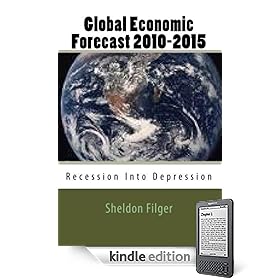
Anyone who though that the global economic and financial crisis that began in 2008 ended due to the “brilliant” expansion of public debt engineered by the policymakers is now getting their wakeup call. As I predicted in my book, “Global Economic Forecast 2010-2015:Recession Into Depression,” a global sovereign debt crisis will precipitate a worsening of the global economic crisis. Furthermore, solving a debt crisis with more debt, tied to fiscal policies that retard economic growth, is not a solution but rather an exhibition of economic and financial insanity.

 With policymaking of this “quality,” it bewilders the human intellect  that anyone still  thinks an economic recovery is just around the corner. There is in fact something just ahead for the global economy, but it won’t be pretty.

global economic crisis , , , , ,

Undisclosed Nation-State Launches Cyber Attack on the IMF

June 13th, 2011

Just when things couldn’t get more bizarre for the International Monetary Fund, a leaked internal memo from the powerful global financial entity indicates it was the target of a highly sophisticated “spear-phishing” hacker attack. The BBC indicated that security expert Tom Kellerman told the Reuters news agency, “that it was ‘a targeted attack’ with code written specifically to give a nation state a ‘digital insider presence’ on the IMF network.”

Other views by computer security experts add to the picture that the IMF was targeted by a state actor wanting a presence inside the databases of the organization. While not enough information has been leaked to identify the likely nation-state or its objectives, I will inject my own speculation.

My view is that such an extreme measure targeting the IMF would likely be initiated by a large economy and global creditor that is vulnerable to massive write-downs of its overseas sovereign debt purchases, especially within the Eurozone, UK and USA. Such an actor might decide that the strategy it must implement to safeguard its investments and long-term fiscal equilibrium requires an extraordinary degree of access  to highly confidential IMF data and policy assessments. Furthermore, such an actor would have already established its interest in cyber-warfare, and has an advanced computer infrastructure of sufficient level to design the highly sophisticated software utilized in the IMF hacking operation.

When it comes to the culprit, I don’t think we are talking about Zimbabwe.


global economic crisis , , ,

IMF in Turmoil; Who Will Replace Dominique Strauss-Kahn?

May 24th, 2011

The International Monetary Fund, as predicted in a recent post, will need to find a new managing director, following the arrest and indictment of Dominique Strauss-Kahn over allegations of sexual assault involving a maid at a Manhattan hotel. With Europe engulfed in a full-blown sovereign debt crisis, and the IMF viewed increasingly as the lender of last resort for the insolvent PIGGS nations on the periphery of the European monetary union, a vacancy at the top of the International Monetary Fund adds further to already elevated levels of market uncertainty.

Among the names being floated for new head of the IMF is the finance minister of France, Christine Lagarde. Her name has been surfaced by a strong faction within the IMF which  believes its head must remain a European, just as the leader of the World Bank is traditionally an American. In any event, whoever is the new leader of the IMF, he or she will head a pivotal backstop to the unraveling of the global financial system and economy that has been severely weakened and tarnished by a scandal that is an allegory for all the ills of the current global economic system.


global economic crisis , , ,

Head of the International Monetary Fund, Dominique Strauss-Kahn, Arrested In New York City!

May 15th, 2011


In  a bizarre twist in the still-evolving global economic crisis, Dominique Strauss-Kahn, the iconic Director General of the IMF, has been arrested in New York in connection with allegations involving the sexual assault on a maid at a Manhattan hotel. According to news reports, the IMF head was removed from a Paris-bound flight just prior to take-off from JFK airport.

Normally, an allegation of sexual assault would not be a relevant factor in the global financial and economic crisis. However, the 62 year-old Strauss-Kahn and the International Monetary Fund he runs is so pivotal a player in the global economic crisis, any hint of scandal or illegality that may force him to resign is bound to have a profound impact on global markets. It was under the leadership of Strauss-Kahn that the IMF was center-stage in constructing the bailouts of insolvent nations in the Eurozone, specifically Greece, Ireland and now Portugal. Should he be formally charged, it is a certainty that the IMF will need to find a new leader. This will add a huge dose of uncertainty just as the European sovereign debt crisis is growing to levels that may have surpassed the possibility of containment.


global economic crisis , , ,

European Debt Crisis In Danger of Metastasizing: IMF Warning On Eurozone

May 12th, 2011


The International Monetary Fund has released a report that contradicts what the Eurozone politicians have been boasting of for about a year. Despite assurances that vast sums of borrowed money loaned to the even more indebted Eurozone nations of Greece, Ireland and very soon Portugal would contain Europe’s sovereign debt crisis from spreading like a malignant cancer to the more substantial economies in the monetary union, the IMF apparently begs to differ.

According to the most recent IMF report on the European debt crisis, “contagion to the core euro area, and then onwards to emerging Europe, remains a tangible downside risk.” In the meantime, European politicians are already frantically looking at renegotiating their bailout loans to Greece and Ireland, with a reduction of the unbearably high interest rates being incurred by Athens and Dublin. But many savvy economists have already warned that these massive bailouts are an expensive fallacy, and will only delay the inevitable: restructuring loans that can never be repaid, or sovereign default.

The tone of the most recent semi-annual IMF report makes it clear that those who actually look at the numbers know that the European sovereign debt crisis is far from over, and has every possibility of getting much worse.


global economic crisis , , ,