Archive

Posts Tagged ‘eurozone debt crisis’

Standard & Poor’s Places Eurozone On Credit Watch

December 7th, 2011

After months of individual sovereign downgrades by the three leading ratings agencies, S & P has now entered a quantum leap by placing almost the entire Eurozone on a credit watch, including the behemoth economies of Germany and France. Furthermore,  Standard & Poor’s followed up by placing the European Financial Stability Facility, the vehicle for supposedly bailing out problematic Eurozone sovereigns and banks, on a negative credit watch. The fact that even the EFSF is on the verge of a downgrade, along with potentially almost all the sovereign states using the euro, is proof positive that the Eurozone debt crisis is irreversible, the politicians have lost control, and when the inevitable downgrades follow this devastating credit warning from S & P, all hell will break loose.

In the meantime, the clownish politicos of the Eurozone continue their interminable series of emergency meetings, continuing to promise a final and complete solution to the Eurozone debt crisis. However, in a rare moment of candor, German Chancellor Angela Merkel admitted that at best, a solution was years away.   Given all that, will China and the other BRIC nations, along with private investors, really want to invest in Euro bonds? 


photo
Officer Larry of the NYPD is on his way to Zuccotti Park in lower Manhattan to arrest peaceful protesters involved with the Occupy Wall Street movement. Being a public spirited member of the New York Police Department, Officer Larry does remind us that there is a global economic crisis underway that rivals the Great Depression of the 1930s.


global economic crisis , , ,

China’s Economy Is Contracting In The Industrial Sector

December 2nd, 2011

The figures for China’s purchasing managers’ index (PMI) for November registered a mere 49 points, according to the China Federation of Logistics and Purchasing. This figure represents a contraction in the crucial Chinese manufacturing sector. It has been due to its role as factory to the world that China’s GDP has been propelled to the second largest in the world. The latest PMI has been amplified by a similar index compiled by HSBC, which is also reporting a contraction in the industrial sector. This dismal news on the supposedly rapidly growing Chinese economy is being attributed to a decrease in exports to the Eurozone countries, now mired in an ever-worsening sovereign debt crisis. The data on China’s PMI is the worst since February 2009, at the tail-end of the free fall contraction in the global economy after the onset of the global economic crisis in the fall of 2008.

How worried should one be about the industrial contraction in China? Many observers have already pointed out that China’s rapid growth at a time of economic decline and stagnation among advanced economies was in large part artificially induced by massive government spending, in particular on uninhabited apartment complexes and unoccupied shopping malls. But more importantly, how worried is China about the economic health of its largest customers, in both the Euozone/UK region and the United States? This is what Chinese Vice Finance Minister Zhu Guangyao said about the current global economic crisis: “The current global crisis may be in some way more severe and challenging than that of 2008 after the collapse of Lehman Brothers.”

The Chinese political leadership is clearly worried about the spillover effects of the Eurozone debt crisis on China. This has led to some radical about-turns in economic policymaking. Concerns about inflation and banks with a significant portfolio of bad loans have been discarded. The authorities in Beijing are again focused on growth at all costs, involving the loosening of monetary policies and requirements on Chinese banks for minimal provision for reserves against bad loans. However, with a much smaller proportion of its economy driven by domestic consumption compared to the Eurozone, U.K. and U.S., there is only so much the government can do to induce growth at a time of stagnation or contraction of its exports to its largest customers. In the final analysis, China cannot go on indefinitely building uninhabited cities as a means of creating “growth” in its GDP. 

Despite all the talk in economic circles about the large economies in East Asia being “decoupled” from the advanced economies in Europe and North America, China is as much a prisoner of the impact of the Eurozone debt crisis as is America-just as Europe and China were prisoners of the subprime mortgage meltdown in the United States. In our integrated global economy, no one is immune to the effects of a legacy of bad economic and fiscal policymaking in Washington and Brussels, least of all Beijing.


photo
Officer Larry of the NYPD is on his way to Zuccotti Park in lower Manhattan to arrest peaceful protesters involved with the Occupy Wall Street movement. Being a public spirited member of the New York Police Department, Officer Larry does remind us that there is a global economic crisis underway that rivals the Great Depression of the 1930s.


global economic crisis , , , ,

Eurozone Debt Crisis: OECD Warning On European Recession

November 29th, 2011

The Organisation for Economic Co-operation and Development has revised its economic forecast for the Eurozone and the UK. In both areas, the OECD is predicting negative growth in Q4 of 2011 and Q1 of 2012. Two consecutive quarters of negative GDP growth meets the technical definition of a recession. Other economists believe that the Eurozone, United Kingdom and the United States have already entered a double-dip recession.

As the global economic crisis worsens, the debt crisis metastasizes and more and more sovereigns are having their public debt downgraded by the ratings agencies, the equity markets are soaring again. Why is that happening, when global economic and financial fundamentals are so rotten? It appears that a false rumour that the IMF was going to bailout Italy from its suffocating public debt was the catalyst for the stock markets to rally strongly. Even when the report was officially denied, the equities maintained their climb. It must be that equities reside in a parallel universe, devoid from the inconvenience of fiscal, financial and economic reality.


photo
Officer Larry of the NYPD is on his way to Zuccotti Park in lower Manhattan to arrest peaceful protesters involved with the Occupy Wall Street movement. Being a public spirited member of the New York Police Department, Officer Larry does remind us that there is a global economic crisis underway that rivals the Great Depression of the 1930s.

global economic crisis , ,

Spain Debt Crisis: Borrowing Costs Soar

November 17th, 2011

The debt crisis contagion in the Eurozone continues to metastasize. With Italy’s ten year government bonds above the red line of 7 percent yields despite a new government, Spain is now approaching that same zone of danger. Spanish government bonds with ten year maturities are very near the toxic level of 7 percent. With the two largest PIIGS nations in the Eurozone on the verge of insolvency, it is quite clear that the attempts to a avoid a contagion from the Greek debt crisis have been a monumental failure.

The politicians in Europe are so desperate that they have actually ditched democracy in a last ditch effort to avert a catastrophic implosion of the Eurozone.  Appointing  unelected governments and forbidding popular votes on economic and fiscal policy , not to mention eroding national sovereignty are the last refuge of the bumbling European politicians. The latest developments in the Spanish debt crisis show that these desperate measures are likely to be as dysfunctional as all other previous efforts to forestall an inevitable disaster from occurring.


photo
Officer Larry of the NYPD is on his way to Zuccotti Park in lower Manhattan to arrest peaceful protesters involved with the Occupy Wall Street movement. Being a public spirited member of the New York Police Department, Officer Larry does remind us that there is a global economic crisis underway that rivals the Great Depression of the 1930s.


global economic crisis , , ,

Italy In Distress: Italian Debt Crisis Now Center Of Gravity In The Eurozone

November 8th, 2011

The Eurozone’s latest Greek debt bailout plan, following previous Greek, as well as Portuguese and Irish bailouts, was supposed to ring-fence the largest PIIGS nations; Spain and Italy. The Spanish economy is highly vulnerable to a raging economic recession and massive unemployment. However, it is Italy, with a two trillion euro public debt and stagnant economic growth, that is now the greatest danger to the Eurozone. The supposed ring-fencing of Italy that was the prime motivation for the Greek debt write-off and bailout is clearly a failure. Only days after the latest Eurozone debt crisis plan, spreads on Italian government bonds are soaring.

The latest yield on ten year bonds issued by Italy is now in excess of 6.6 percent. Should  these yields pass seven percent, it becomes mathematically impossible for Rome to finance its deficits and debt repayments. That would mean that the Italian government would require being bailed out. The problem, however, is that there is not enough resources available in the Eurozone to bail out Italy. The only hope left, and it is a feeble one at best, is that Italian Prime Minister Silvio Berlusconi will resign, and thereby restore some level of market confidence. However, the problems with Italy’s finances go beyond one single bumbling politician. The issues are structural, not personality-based, and so far no real viable solutions have emerged.

A full-fledged Italian sovereign debt crisis will probably be the kiss of death to the Eurozone, at least in its present form.


photo
Officer Larry of the NYPD is on his way to Zuccotti Park in lower Manhattan to arrest peaceful protesters involved with the Occupy Wall Street movement. Being a public spirited member of the New York Police Department, Officer Larry does remind us that there is a global economic crisis underway that rivals the Great Depression of the 1930s.

global economic crisis , , ,

Greece and the Eurozone Debt Crisis: Political Brinksmanship

November 4th, 2011


French President Sarkozy and German Chancellor Merkel had barely popped open the champagne bottles when their supposedly final, permanent fix to the Greek debt crisis got thrown for an unexpected loop. There is a word of Greek origin called “democracy” which has been totally lacking in all the machinations of the policymakers and their financial lobbying friends since the eruption of the global economic crisis. Now, in a surprise move, Greek Prime Minister George Papandreou announced plans for a popular referendum on the latest Eurozone bailout package. Knowing that the public of Greece is overwhelmingly opposed to the bailout crafted in Brussels, the European politicians and the markets castigated the Greek prime minister. This morning, the consensus was that Papandreou would certainly resign and cancel the referendum. Based on these reports from supposedly reliable sources, the stock markets  launched a major rally.

When Papandreou addressed the Greek parliament, however, he did not offer his resignation. He also did not cancel the referendum. Instead, he invited opposition New Democracy leader Antonis Samaras to join him in a national consensus supporting the Eurozone bailout package, with the carrot being that if this occurs, he would then find the referendum unnecessary. Samaras has responded by calling on Papandreou to resign, and for new Greek elections to be held within 6 weeks.

Instead of resolving the Greek debt crisis, the latest effort from the clowns in Brussels has sparked more political instability in Greece, while in the meantime the other PIIGS insolvent Eurozone members, in particular Italy, are headed for their own debt catastrophes, unhindered by the supposed definitive solution to the sovereign debt crisis in Europe that is now up in the air.


photo
Officer Larry of the NYPD is on his way to Zuccotti Park in lower Manhattan to arrest peaceful protesters involved with the Occupy Wall Street movement. Being a public spirited member of the New York Police Department, Officer Larry does remind us that there is a global economic crisis underway that rivals the Great Depression of the 1930s.

global economic crisis , , ,

Eurozone Debt Crisis: Another Failed Bailout Scheme?

October 27th, 2011

Once again, as they have already done countless times before since the emergence of the European sovereign debt crisis, the 27 political head honchos of the European Union have once again boasted that they have saved the global economy from collapse with finally, the real definitive cure for the crisis. However, the only thing really distinct with this latest version of the EU cure is that the numbers are much larger. The politicos claim that they have received agreement from impacted banks to  write off 50 percent of the value of outstanding loans to Greece. Banks in turn will receive recapitalization from the EU. And perhaps most striking in terms of attempting to win investor confidence, the value of the EFSF, or Eurozone bailout fund, will expand from just over $400 billion to around $ 1.4 trillion. No wonder the European politicians are patting themselves on the back, while predictably stock exchanges across the globe are rallying to new, dizzying heights.

So, should we believe that this time, after so many failed attempts also advertised as the real solution, the politicians have finally got it right? I don’t think so. The massive write-down of Greek debt will jeopardize the financial solvency of many European banks, requiring massive recapitalization. That is supposedly why the European Financial Stability Facility is being expanded to a level of one trillion euros. But where will the Europeans get this money? From the same banks they will need to bail out? From investors already spooked by a 50 percent write-down on Greek debt? From China?  From already over-leveraged German taxpayers? In the meantime, the other PIIGS nations are on the brink of insolvency (Portugal, Italy, Ireland and Spain), not to mention fragile eastern European economies, which nobody in the EU will even discuss. No wonder the agreement announced in  Brussels is lacking in specific details.

Nouriel Roubini  tweeted this morning, “Little in EZ plan to restore growth/competitiveness. Without it financial schemes (greek haircut, bank recap, levered EFSF) alone will fail.” Professor Roubini has had a far more reliable track record in predicting the trajectory of the global economic crisis then all the 27 EU political leaders and their army of economic and financial advisors combined. The fact that Nouriel Roubini is already predicting that the EU’s latest bailout plan will fail is far more significant, in my view, then all the stock market rallies being fed by the latest self-congratulatory propaganda coming out of Brussels.


photo
Officer Larry of the NYPD is on his way to Zuccotti Park in lower Manhattan to arrest peaceful protesters involved with the Occupy Wall Street movement. Being a public spirited member of the New York Police Department, Officer Larry does remind us that there is a global economic crisis underway that rivals the Great Depression of the 1930s.


global economic crisis , , , , , ,

Spain’s Credit Rating Continues To Plummet; Is France Next?

October 20th, 2011

In an earlier blog piece, I reported on the fact that ratings agency Fitch had dumped Madrid’s credit rating. Standard & Poor’s had also cut the Spanish government debt rating. Now Moody’s, the other major credit ratings agency, has joined the parade by dropping Spain’s rating by two notches. Furthermore, Moody’s added that France, currently with a AAA rating, faces acute danger that its rating may be dropped in the future.

The Eurozone debt crisis is clearly not being alleviated by the desperate machinations of the bumbling politicians. The crisis is getting worse, it is spreading, and along with that somber reality goes a rising tide of public anger and protest.  The sovereign debt crisis is currently impacting Europe with dire consequences for the entire global economy.


photo
Officer Larry of the NYPD is on his way to Zuccotti Park in lower Manhattan to arrest peaceful protesters involved with the Occupy Wall Street movement. Being a public spirited member of the New York Police Department, Officer Larry does remind us that there is a global economic crisis underway that rivals the Great Depression of the 1930s.

global economic crisis , , , ,

Are European Banks On the Verge of Destruction?

June 30th, 2010

In February 2009, my blog referred to a story that appeared in The Daily Telegraph, a leading UK newspaper, headlined, “European bank bail-out could push EU into crisis.” The essence of the story was that The Daily Telegraph was shown a top secret document, leaked from the European Commission, the executive body that oversees the 27 nation European Union, which warned that the EU’s banking system was contaminated by an ocean of toxic assets. Though the story was ignored by the rest of mainstream media, for the most part, I think it is timely to look again at this secret EU document in the light of the current European debt crisis and growing rumours regarding the insolvency of many leading banks across the continent.

The confidential 17 page European Commission document warned that the European banking system could be holding as much as 18.6 trillion euros in toxic assets. Furthermore, in the wake of the European bank bailout that followed the collapse of Lehman Brothers, the document warned that the cost of a second Eurozone and UK bank bailout would exceed the financial capacity of the European Union. In other words, if Europe’s banking system enters a meltdown in the face of the sovereign debt crisis now plaguing European economies, the EU will be powerless to stop the implosion of the European banking and financial system.

Reviewing what the European Commission warned about more than a year ago, it appears that the document’s authors had an impressively prescient ability to forecast the current European sovereign debt and fiscal crisis. In stark terms, the EU document warned that, “It is essential that government support through asset relief should not be on a scale that raises concern about over-indebtedness or financing problems…Such considerations are particularly important in the current context of widening budget deficits, rising public debt levels and challenges in sovereign bond issuance.”

With Greece essentially insolvent, Spain in the grips of its own sovereign debt crisis and the UK and Italy teetering on the edge, not to mention Ireland, Portugal and Eastern Europe, it seems to me that the worst case scenario hinted at in the leaked document more than a year ago is no longer a speculative possibility, but unfortunately a chillingly realistic forecast of what may very soon be the next great global banking crisis.

global economic crisis , , , , ,

Nouriel Roubini: “From Here on I See Things Getting Worse.”

May 21st, 2010

In an interview with CNBC, the renowned NYU economics professor Nouriel Roubini reverted to his apocalyptic mantle of “Dr. Doom.” He said without equivocation that equities were likely to lose 20% of their current valuation. He pointed out that the Eurozone debt crisis and general weakness in the global economy will create severe challenges for investors.

Regarding the Greek sovereign debt crisis, Roubini described efforts to bail out Athens and other highly indebted Eurozone countries as “mission impossible.” He went on to provide a dire overview of the fiscal crisis gripping many advanced economies.

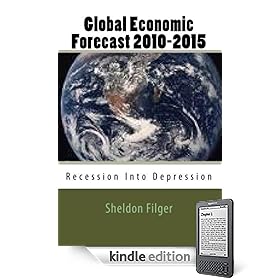
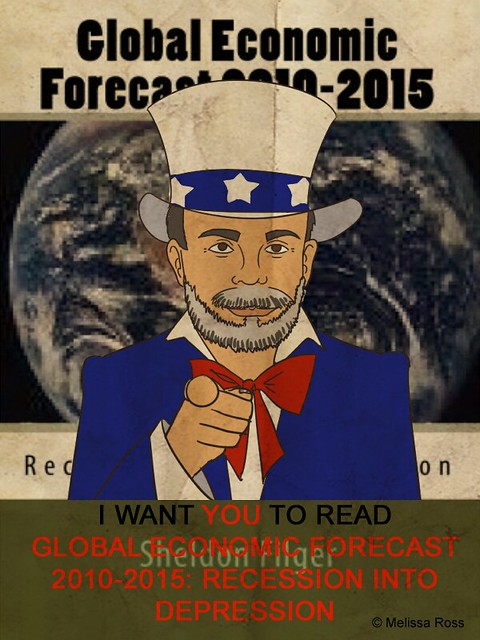
“What needs to be done is clear. We need to raise taxes and cut spending. Otherwise we’re going to get a fiscal train wreck,” warned Roubini. Readers of my book, “Global Economic Forecast 2010-2015: Recession Into Depression” are aware that my own projection is that the growing sovereign debt problem will mark the next phase of the global economic crisis, sparking a synchronized global depression.

global economic crisis , , ,