Archive

Posts Tagged ‘european central bank’

Eurozone Trillion Dollar Bailout is Doomed to Failure

May 12th, 2010

The political masters of the Eurozone delivered their promised “shock and awe” just before Monday’s Asian financial markets opened. If the intention was to create a 24 hour surge in equity prices across the globe, the politicians’ desperate bid to “defend the euro at any price” achieved their transitory objective, at the cost of nearly $1 trillion. However, it is already becoming clear to  investors and analysts globally that this trillion dollar joint Eurozone-IMF boondoggle will utterly fail. Already, the euro has given up almost all of its 24 hour euphoric gains, and is resuming its downward descent.

It is also increasingly clear that key decision makers within the Eurozone played fast and loose with the EMU constitution,  by invoking the “exceptional circumstances” clause of Article 122 of the Lisbon Treaty governing the European Monetary Union. More problematic, it is becoming undeniably obvious that the supposedly independent European Central Bank took orders from the politicians, especially President Sarkozy of France. The ECB president, Jean-Claude Trichet, protests that there was no political interference in the ECB’s decision to start purchasing worthless government bonds from Greece, Portugal and the other insolvent nations that make up the so-called PIIGS. No one believes Jean-Claude Trichet, and Germany in particular will become increasingly alienated from the Eurozone as the ECB engages in the once forbidden monetary sin of quantitative easing.

At the price of one trillion dollars, the Eurozone has just paid the first instalment in what may prove to be the most costly funeral for a currency in modern financial history.

global economic crisis , , ,

Sovereign Debt Crisis

May 9th, 2010

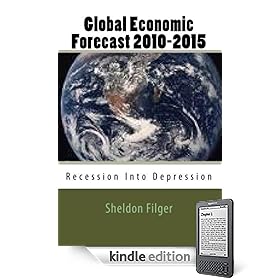
The doomsday events now unfolding in the Eurozone are in line with the prediction in my book, GLOBAL ECONOMIC FORECAST 2010-2015: RECESSION INTO DEPRESSION (available from the homepage of this website, and on Amazon.com in hard copy or Kindle download).

My forecast is that a profound sovereign debt crisis will mark a far more dangerous phase in the global economic crisis, sparking a synchronized global depression. This weekend, the Eurozone political leaders and  the European Central Bank are conducting emergency consultations, boasting that they will unleash some sort of “surprise” by the time Monday financial markets are open.

When politicians such as Nicolas Sarkozy, president of France, boasts about taking on the speculators while the fiscal edifice of Europe crumbles beneath their feet, I am not exactly reassured that these politicos know what they are doing, or comprehend the turbulent economic and financial forces that have been unleashed by their reckless fiscal mismanagement.

Beware, this is not a European problem. It is merely another marker of a profound systemic crisis afflicting the entire global economy. The sovereign debt crisis may be emerging with radical force in the Eurozone first, however the UK, Japan and the United States are the next dominos that will ultimately fall as destructive financial and economic forces beyond today’s clique of mediocre politicians capacity to control let alone comprehend gain velocity.

global economic crisis , , ,

Greek Debt Crisis May Be Canary in the Coal Mine For Eurozone

February 10th, 2010

Greece is in the midst of its worst fiscal crisis since the end of World War II, with a budget deficit now officially stated as being 12.7% of GDP. However, given the past shenanigans when it comes to government bookkeeping in Athens, it would not surprise many if the true deficit ratio to GDP is even higher than currently admitted. The Greek government cannot employ monetary policy as a means to inflate down the value of its national debt, as it is part of the Eurozone. The primary policy option it has left is reducing its budget to sustainable levels, but that would require sacrifices on the part of the population that would likely lead to social disintegration on a massive scale. Already, mass waves of strikes are being planned, in protest at austerity measures being promised by Greek politicians.

Athens is hoping and praying that the wealthier and less profligate members of the Eurozone will bailout Greece, reducing the level of austerity that will be imposed on Greek citizens. Greek political circles clearly hope that the systemic risk posed to the entire European monetary union by its fiscal crisis will compel German and French politicians in particular to swallow the risk of moral hazard, and have their taxpayers bailout Greece. The news that the President of the European Central Bank, Jean Claude Trichet, will be attending an emergency European summit on February 11 in Brussels sent stock markets around the globe soaring, in the hope that Germany and France will bailout Greece. It should not surprise anyone at this stage in the global economic crisis that the best news for investors seems to be taxpayer funded bailouts, as opposed to real economic progress.

The speculation is that the ECB and key Eurozone actors will capitulate, and sacrifice their concern over moral hazard for the sake of preserving the euro. However, this is at best short-term thinking. The fiscal catastrophe Greece finds itself in today, and which Iceland has been experiencing for more than a year, threatens many other European countries. Spain, Portugal, Italy and Ireland, not to mention Eastern Europe and the UK, are all wrestling with exploding levels of sovereign debt. Even if the Eurozone political leaders and the ECB cobble together a bailout of Greece, they simply lack the financial resources to bailout the next wave of European sovereigns that will feel the wrath of a savage fiscal crisis that is actually being made worse by the cumulative taxpayer liabilities that are now expanding towards infinity.

global economic crisis , , , ,

World Bank Issues Gloomy Forecast on Global Economic Crisis

June 24th, 2009
The World Bank has issued an updated forecast on global economic growth. Its previous report in March was dismal enough; it projected a decline in worldwide GDP of 1.7%. The IMF will shortly present its own report, and issue a somewhat rosier picture for the global economy. However, the World Bank is peering at the global economic downturn through a different set of lenses than more optimistic observers, who seem inclined towards finding “green shoots” amid the financial weeds. The World Bank’s June report is now showing a projected contraction in the global economy of negative 2.9%.

This is a disaster-laden forecast, which essentially describes a developed global economy mired in staggering contraction, while the developing world is experiencing a collective growth rate of just above 1%, which undoubtedly would have slipped into negative territory without the inclusion of China’s GDP, which received the only positive projection from the World Bank, which has upped its China GDP forecast to a growth level of just above 7%. However, China’s economic growth is almost entirely based on borrowed money; a massive stimulus program comprising nearly $600 billion to subsidize domestic demand as a counterweight to the sharp decline in Chinese exports.

In 2010, the global economy is projected to return to growth, though on a lackadaisical scale. Even in projecting growth for next year, the World Bank reduced its already weak forecast. What the data seems to reflect, on the macroeconomic level, is that global trade is in free fall, and with the severe contraction of export-driven economic growth, massive borrowing by the sovereign to fund domestic stimulus activity is about the only major economic expansion still occurring. Unfortunately, fiscal policy is only a short-term driver of growth. Even sovereign states eventually exhaust their capacity to borrow and engage in vast levels of deficit spending.

With the World Bank pointing towards more bad news for the global economy, the European Central Bank has come out with a wet blanket of its own. The ECB is warning that pump priming by governments as their primary policy response to the Global Economic Crisis must soon come to an end, or create unacceptable levels of risk to sustained economic development. In particular, the ECB is concerned about the danger of rampant inflation and uncontrolled fiscal imbalances, as national debts of major developed economies, especially within the Eurozone, comprise a growing proportion of their GDP. More alarmingly, the ECB is not alone; other central bankers and economists are also warning that economic policymakers must soon find what they refer to as an “exit strategy” from the massive fiscal deficits that are currently being accumulated with such reckless abandon.

The World Bank’s June forecast data presents economic decision-makers with a conundrum. With 2009 shaping up to be the single worst year for global economic performance since World War II, and 2010 being projected as a year of anemic growth at best, there will be immense pressure on policymakers to enact follow-up stimulus programs, with even greater levels of public borrowing. For example, Nobel Prize wining economist Paul Krugman has consistently called for a much larger stimulus package than the nearly $800 billion Obama package. The argument will be that without more deficits, the globalized recession will be prolonged, and create higher levels of unemployment. However, the fact that in this fragile economic environment some voices within the policymaking establishment are beginning to question the continuation of debt-driven public financing is a sign that there is no clear consensus on how to resolve the Global Economic Crisis.

To add to all the other bad news, economist Nouriel Roubini, the most astute observer of the global financial and economic contraction, is now warning that while a slight economic upturn is possible in early 2010, there is now a growing risk of a “double dip” recession towards the end of 2010, facilitated in large part by the fractured finances of sovereigns that have accumulated staggering levels of public debt.

Finally, even the most optimistic projections concur that global unemployment will continue to accelerate, well into 2010. With fewer wage earners and a continuing credit contraction, it is hard to see any tangible basis for a sustained economic recovery. Remove deficit spending from the equation, and we could see a second Great Depression. Maintain high levels of public borrowing, and the global credit and bond markets will impose their own will, leading to equally cataclysmic economic consequences.

The World Bank’s updated economic forecast does not present a clear roadmap for the future of the global economy. What it does provides is more evidence that the Global Economic Crisis is far from over, and that there is no clear answer to the question of how to bring this globalized disaster to an end, and restore healthy, sustained growth to a battered world economy.


For More Information on “Global Economic Forecast 2010-2015” please go to the homepage of our website, http://www.globaleconomiccrisis.com 


global economic crisis , , , , , ,