Archive

Posts Tagged ‘unemployment rate’

How To Shrink the Unemployment Rate Through More Job Losses

August 9th, 2009

When President Obama trumpeted the first “decline” in the national unemployment rate in more than a year, I thought for a moment that the 44th U.S. president was residing in an alternative universe. How can you lose a quarter of a million jobs in a month, and simultaneously witness the unemployment rate actually post a  decline from 9.5% to “only” 9.4%? However, on reflection, it is I who reside in an  alternative universe. For if you decide to remove a whole chunk of discouraged workers, those whose long-term unemployment is deemed more or less permanent, from the official workforce count, then you can  absolutely post a reduction in the national unemployment rate while still shredding jobs, courtesy of the statistical wizards at the Department of Labor. Easy as toast.

So it is I who must apologize to President  Barack Obama for having committed the heresy of screwing up with logic my understanding of official statistics on employment in America . Of course, it makes perfect sense. Now, let’s just go ahead and save a whole lot of stimulus money by deducting everybody who is unemployed for more than a month from the official national workforce number.

If this pearl of economic policymaking is indeed valid, why not go the next step, and completely solve the problem of our national debt. Even with rising yearly deficits, we can actually reduce the total national debt by just removing a whole category of IOUs that no one seems to be worrying about at the moment. That way, Treasury Secretary Timothy Geithner can withdraw his request before Congress to increase the national debt ceiling to above $12 trillion, or nearly triple the total it was back in 2000. A brilliant solution to the nation’s fiscal imbalance, so it would appear.

But wait a moment. It seems we already are doing that. According to David M. Walker, who served as the Comptroller-General of the United States from 1998 to 2008, if the U.S. were following general accounting rules that are applicable to businesses in the private sector, it would be posting a far higher figure for the national debt. How much higher? According to Walker, there are more than $50 trillion in unfunded liabilities the U.S. government has incurred regarding future Medicare and Social Security obligations.


For More Information on “Global Economic Forecast 2010-2015” please go to the homepage of our website, http://www.globaleconomiccrisis.com 


Fortunately, a high official with the Federal Reserve disagrees with David Walker. Unfortunately, that official, Richard W. Fisher, President of the Dallas Federal Reserve, revealed in a speech delivered in May that the actual national debt of the United States, accurately tabulating all the nation’s obligations, is a cool $100 trillion.

Now maybe all this statistical manipulation being conducted by our government officials is meant to serve some useful purpose, such as to artificially boost investor confidence and create a new stock market bubble. Perhaps Obama and his Wall Street coterie of advisors really do know what they are doing, and sceptics such as myself are just panicky doomsayers. However, I really do hope America’s foreign creditors are blissfully ignorant as to the true state of the U.S. economy and its fiscal reality. Heaven help us if they stop believing Washington’s math.

global economic crisis , , , ,

Nouriel Roubini Speaks Truth to Power

July 21st, 2009

When media reports surfaced last week claiming that the prophet of doom of the Global Economic Crisis, NYU economics professor Nouriel Roubini, had  “improved” upon his previously gloomy economic forecast and predicted the recession would end by the close of 2009, a stock market rally was ignited. It seems it does not take much to facilitate a bear market sucker’s rally on Wall Street at this time of global economic distress, including false rumours. To his credit, Roubini swiftly set the record straight with the following comment on his blog:

“It has been widely reported today that I have stated that the recession will be over ‘this year’ and that I have ‘improved’ my economic outlook. Despite those reports - however - my views expressed today are no different than the views I have expressed previously. If anything my views were taken out of context.”

Nouriel Roubini has consistently stated that he expected the current recession-by far the worst America has experienced since World War II- to terminate by the close of the year. This has been his longstanding forecast. Thus, when he repeated this consistent prediction of his, the media went wild with excitement, discarding the continuity of his forecast and presenting his belief that by the close of 2009 the recession would end as a surprise revelation. With business journalism like this, no wonder the Dow Jones is searching new highs even as employment numbers continue to plummet.

What is noteworthy about Roubini’s most recent insights on the economic situation are their increasingly gloomy tone related to the mid-term and long-term prospects for the American economy. This is largely predicated on the growing fiscal imbalance in connection with the public indebtedness of the United States. Though a supporter of the vast deficit-driven stimulus programs and expensive bailouts of the financial sector owing to his belief that to negate these policy responses would have resulted in the collapse of the global financial system and the free fall contraction of the U.S. economy, Roubini is not unmindful of the their consequences. In that sense, he parts company from other advocates of deficit-creating economic stimulus packages, including Paul Krugman, who prefer to discard the danger of the vastly-expanding debt of the federal government.

In addition to his concern about the ramifications of unprecedented levels of budget deficits, Roubini is also worried that the end of the recession he has long forecasted will now be only temporary, to be followed by a double dip recession during the latter half of 2010, interrupted by anaemic growth of less than 1%.

The forces contributing to what, at best, will be a weak recovery in 2010 are linked to the uniformly negative statistics on employment which, according to Professor Roubini, have a direct impact on an economy as highly dependent on consumer spending as America’s. According to Roubini, commenting on the latest employment numbers,  “these raw figures on job losses, bad as they are, actually understate the weakness in world labor markets. If you include partially employed workers and discouraged workers who left the U.S. labor force, for example, the unemployment rate is already 16.5 per cent. Monetary and fiscal stimulus in most countries has done little to slow down the rate of job losses. As a result, total labor income — the product of jobs times hours worked times average hourly wages — has fallen dramatically.”

In his recent observations on declining labor income and its relationship to the continuing financial and economic crisis, Roubini identifies how this factor will exacerbate several interlocking indices. Consumer loan defaults across the board-mortgages, students loans, credit card debt-will continue to increase, adding to the level of toxicity of assets on the balance sheets of banks, and extending the credit crunch. Government revenues will decline while the need to fund unemployment benefits and other social expenditures will grow, further increasing budgetary deficits. Professor Roubini summarizes the growing contradictions in utilizing fiscal and monetary policy responses as the primary sovereign means of countering the worst global economic disaster since the Great Depression as follows:
“The higher the unemployment rate goes, the wider budget deficits will become, as automatic stabilisers reduce revenue and increase spending (for example, on unemployment benefits). Thus, an already unsustainable U.S. fiscal path, with budget deficits above 10 per cent of GDP and public debt expected to double as a share of GDP by 2014, becomes even worse. This leads to a policy dilemma: rising unemployment rates are forcing politicians in the U.S. and other countries to consider additional fiscal stimulus programs to boost sagging demand and falling employment. But, despite persistent deflationary pressure through 2010, rising budget deficits, high financial-sector bailout costs, continued monetisation of deficits, and eventually unsustainable levels of public debt will ultimately lead to higher expected inflation — and thus to higher interest rates, which would stifle the recovery of private demand.”
This leads to what economists refer to as a “W” or double dip recession. In other words, the very policy responses politicians and their advocates claim are vital to restoring the economy may, by the end of 2010, become the principal enabler of forces that will unleash round two of the Global Economic Crisis.

Nouriel Roubini had warned for years that the subprime mortgage sector would bring about financial and economic calamity, and take down much of the investment banking industry. Today we would all be wise to listen carefully to Professor Roubini’s warnings on the growing danger of a double dip recession and the long-term implications of a fiscal roadmap being pursued by our politicians that, in Roubini’s prescient words, is “unsustainable.” Given his track record, we can only discard the truth of which Roubini speaks at our peril.

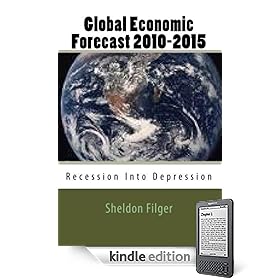
 

For More Information on “Global Economic Forecast 2010-2015” please go to the homepage of our website, http://www.globaleconomiccrisis.com 


global economic crisis , , , , , ,

Jobs Crisis Threatens World Peace

January 7th, 2009

What began initially as the Global Financial Crisis has now become the Global Economic Crisis. The global demand destruction that is raging is now leading to a massive jobs crisis that will ravage the societies of virtually every nation on the planet. Governments throughout the world will attempt to address the jobs crisis in the same manner they have been responding to the financial and economic crisis: they will beg, borrow and print money measured in the trillions of dollars to throw at the problem. Their results in combating monstrous levels of unemployment will likely be as ineffectual as our political masters and their “experts” have been in attempting to ameliorate every other aspect of the Global Economic Crisis.

Later this week, updated unemployment statistics for the United States will be released. President-elect Barack Obama has already warned that they will be “sobering,” which likely means he already knows how bad they are. However, the U.S. government deliberately understates the true unemployment rate when they release official numbers. Among the statistical gymnastics utilized by the U.S. Labor Department is the expediency of excluding discouraged jobless who have given up hope of finding employment; they simply do not exist when the U.S. government counts its number of unemployed workers. When this component of the unemployed is counted, the true jobless rate in the United States is in excess of 12%, about half the peak rate experienced during the Great Depression. No wonder Nobel Prize winning economist Paul Krugman has now joined the list of those proclaiming that the U.S. is now in an economic depression.

The consumer demand of the U.S., driven by debt, is now collapsing with the growing jobs crisis. This is leading to demand destruction for those export goods developing economies around the world depend on to employ their teeming masses. During the course of the year the jobs crisis will clearly be a global phenomena, as are all the other factors that characterize the ongoing Global Economic Crisis. While the ultimate result is unclear, history tells us that massive unemployment on a global scale rips asunder social cohesion, facilitates political extremism and despotism, and exacerbates international tensions. The jobs crisis may ultimately contribute to a geopolitical crisis that threatens the very peace of our planet.


global economic crisis , , , ,